XERF · Monopolar RF · A Physician's Perspective
Stamping vs Sliding: Here we go again…
The short version
Is stamping the proper way to use XERF, with sliding just an option for comfort? The manufacturer's own sponsored clinical study does not support that.
In a 2026 prospective, four-centre US study of XERF, sponsored by Cynosure Lutronic, the investigators used sliding, stamping or both, depending on the area of the face. Sliding was the technique for broad, less contoured areas, to give uniform coverage. Stamping was used on contoured or bony areas. A combination was used where both coverage and focal tightening were wanted. At 90 days, 92.3% of patients were rated as improved.
The study did not compare the two techniques, so it cannot be used to say sliding is better. It also cannot be used to say stamping is better. Which is really the point.
Why this question keeps coming back
Stamping versus sliding has been argued about in monopolar RF for close to twenty years. I wrote about it earlier this year, and I thought that would be the end of it for me. With XERF, the conversation has come back again, this time around whether stamping is the technique the device was designed for and sliding is mainly there for comfort.
Professionals sharing what works for them is how this field learns, and I have learned a lot over the years from colleagues who treat very differently from me. But when a technique is said to give better results, that is a clinical claim, and it should come with clinical evidence, whoever it comes from.
So I went back to the manufacturer's own published data.
The study
Weiss, Wang, DiBernardo and Bhatia published a prospective multicentre study of XERF in Cureus in March 2026. It ran under an FDA investigational device exemption, was approved by an independent review board, and followed the same protocol at four US centres:
- Dr. Robert A. WeissMaryland Dermatology Laser, Skin & Vein Institute, Baltimore, Maryland
- Dr. Jordan V. WangLaser & Skin Surgery Center of Pennsylvania, Devon, Pennsylvania
- Dr. Barry DiBernardoNew Jersey Plastic Surgery, Montclair, New Jersey
- Dr. Ashish C. BhatiaOak Dermatology, Naperville, Illinois
The study was sponsored by Cynosure Lutronic, which provided the device, consumables and a modest research grant to the sites, and supported data management and statistical programming. The investigators were responsible for running the study and for the final manuscript.
- 39 patients (37 women, 2 men), aged 28 to 70, average 54, Fitzpatrick skin types I to IV.
- Two treatments, four weeks apart, at shallow, middle or deep mode depending on the area and the concern.
- The EFFECTOR 60 tip for everyone, no topical anaesthetic, energy levels 1 to 10 titrated to the patient.
- Photographs and assessments at 30 and 90 days after the final treatment.
Read the full study
Weiss et al. 2026, Cureus 18(3): e104546
How they used sliding
This is the part that matters for the debate. The methods section describes exactly how each technique was chosen:
“Sliding mode was used for broad, less contoured areas to provide uniform coverage with better comfort, whereas stamping mode was used for contoured or bony areas for stable contact and localized energy delivery; a combined approach was used when both coverage and focal tightening were desired.”
Weiss et al., Cureus 2026, Materials and Methods
| Technique | Where it was used | Reason given in the study |
|---|---|---|
| Sliding | Broad, less contoured areas | Uniform coverage, with better comfort |
| Stamping | Contoured or bony areas | Stable contact and localised energy delivery |
| Combination | Areas needing both | Coverage plus focal tightening |
Source: Weiss et al., Cureus 2026. The gel was applied “as a sliding agent to facilitate smooth movement”, so movement was planned for from the start of every treatment.
Comfort is mentioned, and it is a real benefit. But in this study it sits alongside the main reason sliding was chosen, which is uniform coverage across the broad areas of the face. On most faces, those broad areas are a large share of what gets treated. Sliding was a treatment technique here, not an afterthought.
The same methods section describes the Wave Fit pulse, the RF pulse train of subpulses whose energy and timing are adjusted to the selected depth and level. Every treatment in the study was delivered with it, by sliding, stamping or both. If sliding compromised Wave Fit, it would be an unusual thing to build into the manufacturer's own US trial.
Moving the handpiece does change how energy is spread across the tissue. That is true, and it is exactly what my earlier article was about. But that is a question of dose, overlap and coverage, and it applies just as much to a poorly planned stamping grid as it does to sliding at the wrong speed.
What it found
- On average about 569 shots per treatment, and about 56 kJ in total.
- Average pain of 4.2 out of 10, without anaesthetic.
- No lasting adverse events. Redness and swelling were mild and settled on their own.
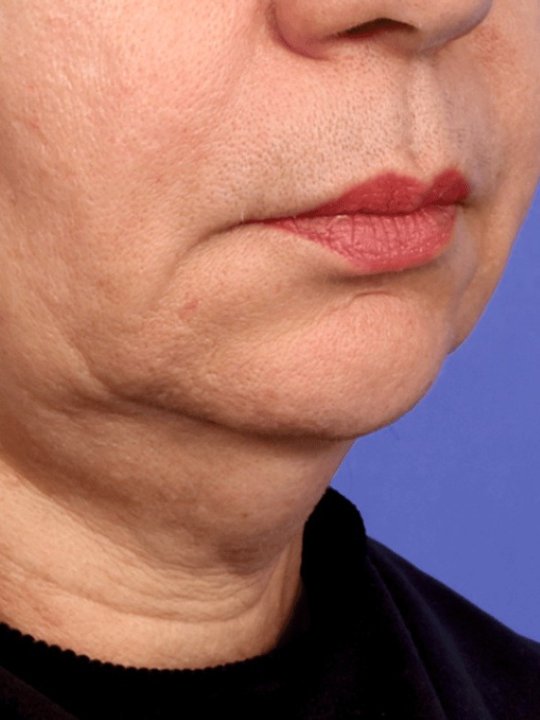
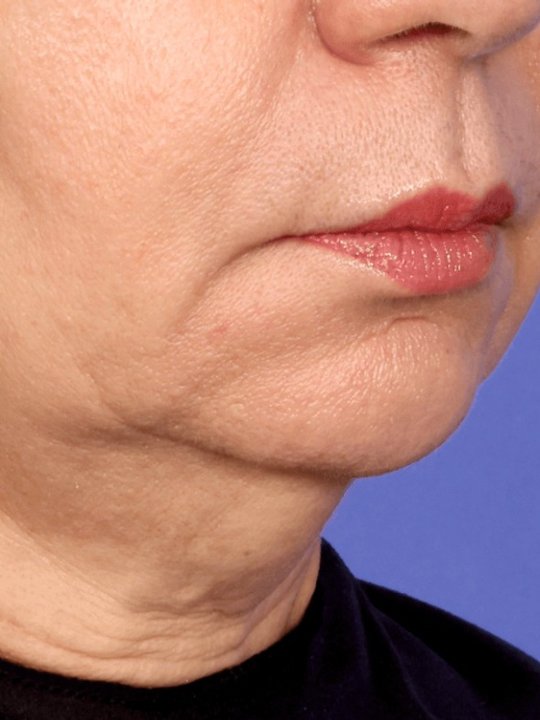
60-year-old woman, two treatments in deep mode, levels 5 to 7.
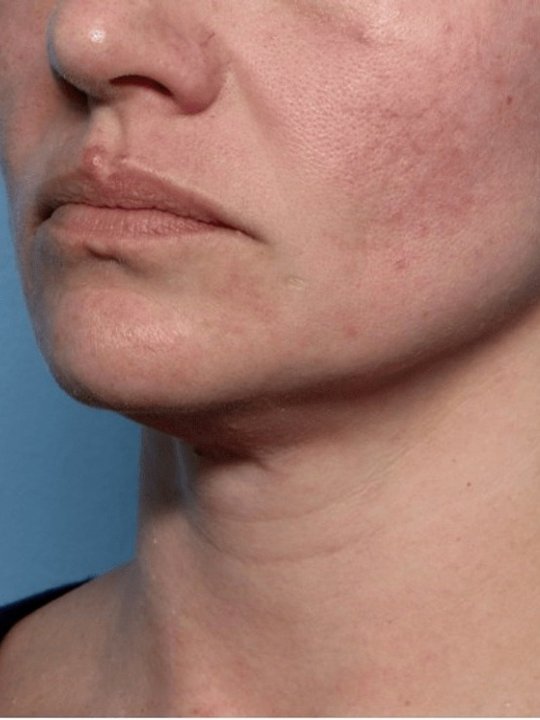
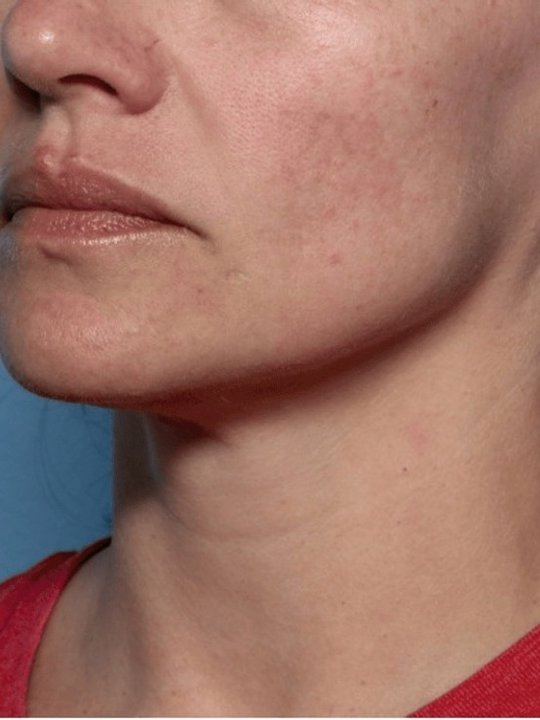
42-year-old woman, two treatments, middle and deep modes, levels 3 to 6.
What it does not prove
To be fair to both sides, this study has clear limits, and the authors list most of them themselves:
- It did not compare sliding with stamping. There are no results broken down by technique.
- There was no control group, and the investigators who treated the patients also scored the photographs.
- 39 patients, two treatments, 90 days of follow-up. Collagen remodelling continues for months after RF, so longer follow-up would tell us more.
- Depth of heating was not measured in these patients. The temperature data quoted in the paper come from earlier pig studies.
- Skin types V and VI were not included.
So this study does not show that sliding is better than stamping, or even that the two are equal. What it does show is that a manufacturer-sponsored, multicentre XERF protocol used sliding as a deliberate part of treatment and got good results. That is hard to reconcile with the idea that sliding is only for comfort.
Perhaps we're asking the wrong question
As I wrote last time, stamping and sliding are two ways of organising the same energy in space and time. Stamping builds the dose through overlapping stationary pulses. Sliding builds it through controlled speed, contact and repeated passes. Both can be done well, and both can be done badly.
In my own practice I mostly slide, and I use speed to control the dose: a little quicker over thin skin like the forehead, slower over thicker areas like the cheeks. Other experienced clinicians stamp beautifully and get excellent results. I don't think either of us is wrong.
If a clinician can safely and consistently deliver an adequate thermal dose to the right tissue, the movement of the handpiece is a means to an end, not the end itself.
If someone believes stamping gives better results, that is a fair hypothesis. A split-face study comparing the two at matched energy, with blinded assessment, would be a genuinely useful piece of work, and I would read it with interest. Until then, it is a preference, and it should be shared as one.
If you are a patient
Please don't worry about whether your provider slides or stamps. Both are recognised ways of using XERF. What makes the bigger difference is the person holding the handpiece: their experience, how they plan the treatment for your face, and whether they reach a proper endpoint rather than just counting shots.
If you would like to know how we approach XERF at Skin Trek, this page explains it, and a consultation is the place to talk it through.
If you treat with XERF
If you have built your protocol around sliding, the manufacturer's own published multicentre data include it. Keep following your device training and the instructions for use, keep refining your technique, and keep measuring your results. And when someone tells you your technique doesn't work, it is completely reasonable to ask them for the evidence.
Common questions
Is stamping better than sliding for XERF?
There is no published comparison showing that either technique gives better clinical results with XERF. In the 2026 prospective multicentre US study of XERF (Weiss et al., Cureus), investigators used sliding for broad, less contoured areas, stamping for contoured or bony areas, and a combination where both coverage and focal tightening were wanted. At 90 days, 92.3% of patients were rated as improved by the investigators. The study did not compare the techniques against each other.
Does sliding compromise the XERF Wave Fit pulse?
No published evidence shows that it does. The manufacturer-sponsored 2026 multicentre XERF study delivered treatment with the Wave Fit pulse and used sliding, stamping or both depending on the area. Movement can change how energy is distributed across the tissue, but that is a question of dose and coverage, which applies to both techniques.
Who funded the XERF multicentre study?
Cynosure Lutronic provided the device, consumables and a modest research grant to the four US sites, and supported data management and/or statistical programming. The investigators were responsible for clinical conduct, interpretation and the final manuscript.
Sources
39 patients at four US centres, two XERF treatments, followed to 90 days. Sponsored by Cynosure Lutronic. Open access under CC BY 4.0, download the PDF. Source for all figures on this page.
The earlier Skin Trek article on the heat-transfer side of the debate: thermal dose, rhythm, overlap and why both techniques can work.
Accurate as of November 2026.